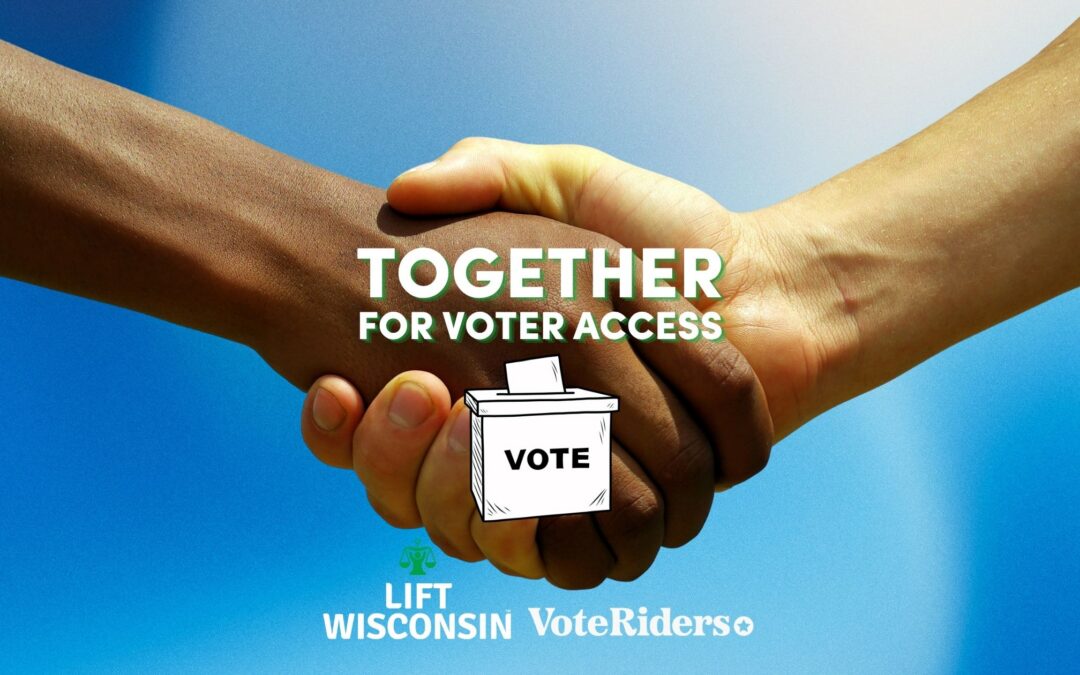
Lift Wisconsin has partnered with VoteRiders, the nation’s largest voter ID assistance nonprofit, so that any Wisconsinite who needs a Wisconsin driver’s license or state ID to vote can be referred directly to VoteRiders for free help. If you came to a LIFT Wisconsin clinic without a valid Wisconsin ID, that gap now has a direct path to a solution.
Why this partnership matters
Wisconsin law requires every voter to show an accepted photo ID at the polls and to provide proof of residency when registering to vote. For most people, that means a Wisconsin driver’s license or a Wisconsin state ID card.
In Wisconsin, anyone who doesn’t have the documents they need to get an ID faces a real barrier in exercising their constitutional right to vote – and it shows up at places like our clinics.
“People come to our clinics who need a driver’s license reinstated, an ID for work or housing, or an ID to vote. Until now, we couldn’t help with the voter ID piece. Now we can connect them with a person on the phone who can walk them through the process.” – Legal Navigator volunteer
Through our partnership with VoteRiders, we’re closing that gap.
What VoteRiders does
VoteRiders is the nation’s foremost nonprofit focused exclusively on voter ID access and voter ID education. In 2025, VoteRiders reached 5 million people with information and services, and plans to reach 10 million by November 2026. In Wisconsin alone, VoteRiders has 25 partners – and now we’re proud to be one of them!
VoteRiders’ services are free, and include:
- Help obtaining a valid voter ID, including underlying documents like birth certificates, Social Security cards, and proof of residency.
- Voter registration guidance, including same-day registration rules in Wisconsin.
- Answers to voting rights questions, including rights restoration after a conviction.
- Wisconsin-specific information on what counts as an accepted ID and what to do at the polls.
In Wisconsin, VoteRiders’ State Director already supports voter registration efforts at the Milwaukee County Jail by helping incarcerated and re-entering voters obtain the IDs and underlying documents they need.
Who this partnership serves
The partnership is built for any Wisconsinite who doesn’t have a valid Wisconsin ID. That includes:
- People impacted by incarceration who are re-entering their communities and need an ID for housing, employment, benefits, and voting.
- Domestic violence survivors fleeing without documents.
- Students and recent movers whose out-of-state ID no longer matches their Wisconsin address.
- Anyone whose Wisconsin driver’s license or state ID has been expired long enough that it’s no longer accepted.
In Wisconsin specifically, 68,279 residents are disenfranchised due to a felony conviction — 1.53% of the state’s voting-eligible population — and the burden falls hardest on Black Wisconsinites, of whom 8.92% (22,029 people) are disenfranchised, nearly six times the statewide rate. This figure counts only those barred from voting under state law; it does not capture the additional Wisconsinites effectively shut out because they lack documents, lack information about restoration, or cannot navigate the DMV process alone.
Wisconsin has a process for restoring voting rights after a conviction — VoteRiders can help clarify eligibility and connect people to that process.
Additionally, Wisconsin law requires the DMV to issue a free state ID card for voting purposes to any U.S. citizen who will be 18 or older by the next election. Since 2011, the DMV has issued nearly 1.5 million free IDs for voting, but that process can be confusing or intimidating for many Wisconsinites (especially if English is not their first language).
The challenge is getting eligible voters through the door with the right documents. That’s the gap the Lift Wisconsin × VoteRiders partnership closes.
How the partnership works
Here is what happens now when someone LIFT is serving needs an ID:
- Lift Wisconsin assesses the legal issue. A client may come in for eviction record removal, help restoring a driver’s license, or a child support matter, and it comes up that they don’t have a Wisconsin ID or driver’s license and thus can’t vote.
- Lift Wisconsin refers the client directly to VoteRiders.
- VoteRiders contacts the client and walks them through the next steps. That includes identifying which documents they need, helping them obtain missing underlying documents, paying fees where eligible, and providing rideshare support in some cases.
- The client obtains a Wisconsin ID or driver’s license — and now has the ID they need to register and vote.
Important: People referred to VoteRiders must have a personal phone on which VoteRiders volunteers can reach them. VoteRiders’ team works by phone and text — they do not currently offer in-person home visits.
If you are a Wisconsinite who needs help getting a Wisconsin ID or driver’s license to vote, contact VoteRiders.
Wisconsin voter ID Q&A
Here’s the practical information one needs to know, sourced from VoteRiders’ Wisconsin state page splcenter.org:
| Question | Answer |
| Do I need an ID to vote in Wisconsin? | Yes — a photo ID is required to vote in person, and to request an absentee ballot for the first time. |
| What IDs are accepted? | A full list is available on the Wisconsin Elections Commission website. |
| My Wisconsin ID expired. Can I still use it? | Most Wisconsin driver’s licenses and state IDs are still accepted for voting if they expired after November 5, 2024. |
| Can I get a Wisconsin ID for free? | Yes. The DMV issues a free state ID card to U.S. citizens age 18 or older by the next election. Check the “ID for FREE” box on the Wisconsin Identification Card application (MV3004). |
| What if I don’t have all the documents the DMV asks for? | You can use the DMV ID Petition Process. The DMV will give you a “FOR VOTING PURPOSES ONLY” receipt you can use to vote within 60 days while your identity is being verified. |
| What if I don’t bring an ID to the polls? | You can cast a provisional ballot. To make it count, return with an accepted photo ID before polls close on Election Day, or bring one to your municipal clerk’s office by 4:00 PM the Friday after the election. |
| I have a felony conviction. Can I vote in Wisconsin? | It depends on whether your civil rights have been restored. VoteRiders can help you figure out your eligibility — start at voteriders.org/states/wisconsin/register. |
| Do I need a REAL ID to vote? | No. A REAL ID is for federal identification purposes (air travel, federal buildings); voting does not require one. |
Bottom line: If a Wisconsinite has a Wisconsin address, is a U.S. citizen, and is 18 or older by the next election, there is a path to a free ID, and VoteRiders can walk you through it!
Why this fits Lift Wisconsin’s mission
Lift Wisconsin exists to dismantle civil legal barriers that keep Wisconsinites from achieving economic stability. We do that through three channels: in-person legal clinics, trained justice navigators, and our Legal Tune Up online tool. Every one of those channels regularly surfaces the same underlying problem — a client needs an ID and doesn’t have one, and the absence of that ID blocks them from getting a job, securing housing, opening a bank account, accessing benefits, or voting.
A Wisconsin ID isn’t just a voting document. It’s an economic mobility document. The VoteRiders partnership means our clinics no longer have to send someone home with a stack of paperwork and a wish. They can connect that person, by phone, to a specialist whose entire job is to remove exactly this barrier — at no cost to the client.
Frequently Asked Questions
Who is the new Lift Wisconsin × VoteRiders partnership for?
Any Wisconsinite who needs help obtaining a Wisconsin driver’s license or state ID — including people impacted by incarceration, domestic violence survivors, low-income residents, students, and anyone whose ID has lapsed or been lost.
Is the help free?
Yes. Both Lift Wisconsin’s legal assistance and VoteRiders’ voter ID help are free to the client. In some cases, VoteRiders also covers ID fees and transportation costs voteriders.org.
Do I need a phone to get help from VoteRiders?
Yes. VoteRiders’ volunteers reach people by phone and text. Make sure you have access to a personal phone that VoteRiders can contact before a referral is made.
What if I just need information about Wisconsin voter ID rules — not a referral?
You can find up-to-date Wisconsin-specific rules at voteriders.org/states/wisconsin or call VoteRiders’ helpline at 866-432-8683.
Can VoteRiders help me get a Wisconsin ID if I’m currently incarcerated?
In Wisconsin, VoteRiders’ State Director already supports voter registration efforts at the Milwaukee County Jail, including help obtaining underlying documents like birth certificates and Social Security cards liftwisconsin.org.
Can VoteRiders help me if I’ve been convicted of a felony?
VoteRiders can help you figure out whether your voting rights have been restored in Wisconsin and connect you with the right process.
Will VoteRiders help with anything other than voter ID?
VoteRiders’ mission is to eliminate ID barriers to the ballot box. But because the same documents (birth certificate, Social Security card, state ID) are required for housing, employment, and benefits, helping someone get a voter ID often unlocks all of those.
I’m a community organization in Wisconsin. Can I partner with Lift Wisconsin too?
Yes. Lift Wisconsin was built on a model of partner collaboration, and we welcome new partnerships. Visit liftwisconsin.org/about-us/partners or contact us through the website.
About the organizations
Lift Wisconsin is a Wisconsin-based nonprofit that uses technology-driven legal assistance to dismantle civil legal barriers to economic stability. Lift Wisconsin provides free help through in-person clinics, a trained network of justice navigators, and the Legal Tune-Up online tool.
VoteRiders is the nation’s largest voter ID assistance nonprofit. Its mission is to eliminate ID barriers to the ballot box so every eligible voter can cast a ballot that counts. VoteRiders provides free, one-on-one help with voter ID, registration, and voting rights questions, with more than 2,400 partner organizations and 14,000 volunteers nationwide.