As a Community Justice Worker (CJW), I am always looking for opportunities to connect with other CJWs and share our experiences to help increase access to justice.
The access to justice gap reaches all corners of our country, and especially the rural areas. At the 2026 National Legal Aid & Defender Association Conference in St. Louis, I had the privilege of hearing from a CJW who is working to mitigate the access to justice gap in remote areas of Arizona. She serves an indigenous nation that can only be accessed via helicopter, and she described the struggles she’s had while trying to assist this group – they would not let her in, despite all her efforts. She noted, “They just don’t trust me, because I am not a part of their community.”
It all boiled down to that simple fact.
As she went on with her story, the nuances that shape this situation became clear: a long history of how this group had been purposely targeted and deceived in the past by our government, and by other outsiders – all of which has resulted in an understandable, deeply embedded mistrust towards anyone who is not part of their group, regardless of race and background
I understood exactly what frustrations and disappointment she was feeling regarding her outreach attempts, especially despite her diligent and consistent efforts. However, I also completely understood why this group was so wary of the outreach and why that likely would not change anytime soon.
But we must keep trying. Community Justice Workers are uniquely positioned to bridge that mistrust gap, as we see firsthand how much trust is a contingent consideration for some communities and people. Significant tension exists for many Americans when they are first thinking of taking a step towards protecting themselves through our civil legal system.
Our legal system was created by attorneys, for attorneys – not for everyday Americans. That’s where Community Justice workers can help bridge that gap.
Trust is a contingent consideration for some communities and people. The misalignment between who the system was designed by and who it’s meant to be designed for does not require a fancy legal degree to be felt. This underlying sense of alienation leads to the larger sense of mistrust in attorneys and our system as a whole. Only 28% of low-income Americans believe that people like them are treated fairly in the American civil legal system, and only 39% of those low-income Americans believe that people like them can protect and enforce their rights using the system (Legal Services Corporation, Justice Gap Report)
Trust is important for the people in our legal system, its proceedings, and the people who are meant to be guiding folks through these processes.
Trust is an essential component to cultivate when trying to close the access to justice gap. The role of Community Justice Workers in the broader legal system has been born from bridging the gap between Americans with nonlegal backgrounds and the system they are trying to navigate.
Through my role at LIFT Wisconsin, I have had the opportunity to shape what this looks like and means for our organization and for Wisconsinites. One of the main ways I have been able to connect with more Wisconsinites is through Spanish-speaking communities, providing services in their language. Coming from a first-generation background to immigrant parents, I was already no stranger to translating complex language to Spanish. As an active community member and nonlawyer, many folks are also more comfortable asking questions or sharing information with me that otherwise may hesitate to voice. Folks trust me to assist them with certain legal process-related tasks and trust the information I share with them. As a CJW, I still received specialized training focused solely on the areas of law LIFT assists with, and that I could support. Just like the law, this training is always changing and being supplemented!
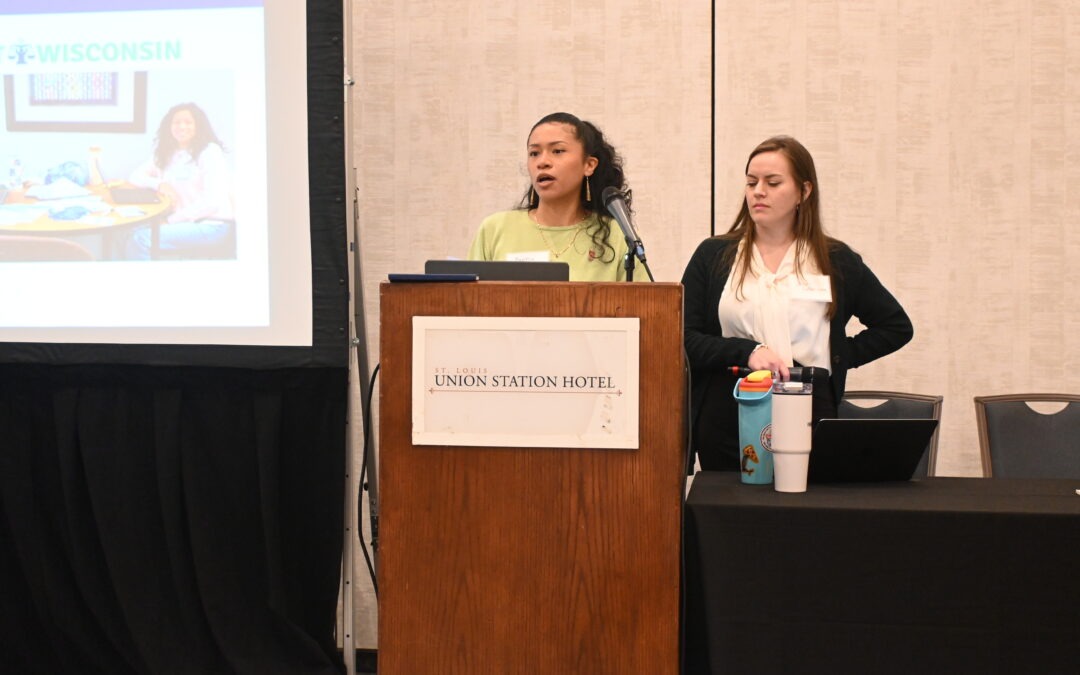
All of this combined assiduous work came together at the NLADA Annual Conference, where I – along with LIFT’s Justice Coordinator Jessie Lutter-Long – presented at Frontline Justice’s pre-conference convening. We were invited to join Ascendium Education Group to speak about the Community Justice Worker (hopefully soon to be called “Legal Advocates”) initiative in Wisconsin, how they have been pushing for policy changes for this, and how LIFT Wisconsin has approached community justice work.
Over the past year (the first year LIFT has participated in the Community Justice Worker program), Jessie and I have learned a lot. Jessie spoke about her experience as a supervisor, and how developing the Community Justice Worker curriculum has come to fruition. I shared my experience so far as a CWJ and the lessons I’ve learned. We both offered advice for other Community Justice Workers and growing initiatives.
The lesson that I shared was about finding my place in this developing and liminal legal space. At first, I felt bad when folks would tell me their issue, and I would have to tell them that I could not help, as I am not an attorney, and I did not feel very helpful in those moments. However, over time, my perspective on this has shifted, and I feel much more comfortable operating and helping within my Unauthorized Practice of Law (UPL) capacities. I stopped viewing it as “limits” and started embracing the defining features of my role – this even opened me up to helping folks in more ways. Essentially, knowing that you are still able to help even if you don’t have those same certifications and welcoming that has been a huge lesson on perspective for me.
One challenge I shared was about how to redirect a conversation with a person to extract the most pertinent information to best understand the situation. Letting a person get thoughts off their chest can many times be just as helpful as any other legal services, but it is also important to know how to be efficient with our time, while remaining empathetic.
Finally, the advice I presented was of the utmost importance one should place on the resources included in the onboarding of a CJW. Having a strong understanding of the people and history in your area cannot be understated. It’s easy to research and understand the systems that are working in your area, but understanding the people, their backgrounds, their histories, common struggles, how they all intersect all compounds to influence their everyday lives and inform how they interact with the systems, which is crucial to being able to serve your community. Generally, this all goes back to the mistrust that a lot of folks have against the justice system.
The justice system doesn’t consider nuances, it’s all pretty set in stone. But If you’re going to be serving a community, you need to understand the nuances of that community.
This presentation was particularly special because of the different folks in attendance: Community Justice Workers from different states and communities, the supervisors and host site members supporting them, folks from civil-legal justice adjacent organizations, expert voices helping shape this project, and of course, Frontline Justice team members, including their founding CEO, Nikole Nelson.
It was particularly awesome to meet and speak to the other Community Justice Workers from across the country. It was amazing to see how this project is developing in other parts of the country. I had the opportunity to connect with Justice Workers from places like Arizona, Utah, and New Mexico – each of them serving communities so uniquely their own, I could not help but be in awe hearing their stories! I was particularly struck by how different “closing the access to justice gap” looks based not only on the community and location, but on the actual people they are serving and how their histories inform those Community Justice Workers’ approach.
It was inspirational to meet folks like Nikole and Celine Ta of Frontline Justice, who are working diligently on this initiative to reshape how legal services can reach more everyday Americans, and rethink how our American legal system works.
Lastly, a special thank you to Cailean Robinson for laying the groundwork that brought this all together, and Ascendium Education Group for their support and for making this opportunity possible!